Final Conference Report – 25 November 2025
The final conference of the European Green Team project was held on 25 November, bringing together more than a hundred participants online to explore three years of work focused on a central question: how to help federations, clubs, and sports organizations organize more sustainable, inclusive events that align with European climate goals.
Hosted by Eva Jacomet, Head of European Affairs at Sport and Citizenship, the event highlighted the concrete results of the project, field experiences, and perspectives on the challenges posed by climate change.
A project putting federations at the heart of the transition
At the opening, Isabel Perez, Secretary General of UFEC, and Milena de Murga, Head of the International Department and Social Action, emphasized the founding ambition of the Green Team project: to create a simple, accessible, and replicable methodology to support federations in organizing more responsible events.
The initial observation is clear:
- The sports sector is becoming aware of its environmental impact
- Events must become vectors of inclusion
- Ecological transition can only progress by mobilizing all actors in a territory
Milena de Murga highlighted an important point: “Sustainability begins with awareness.” Awareness is the first step, followed by practical tools that allow immediate action.
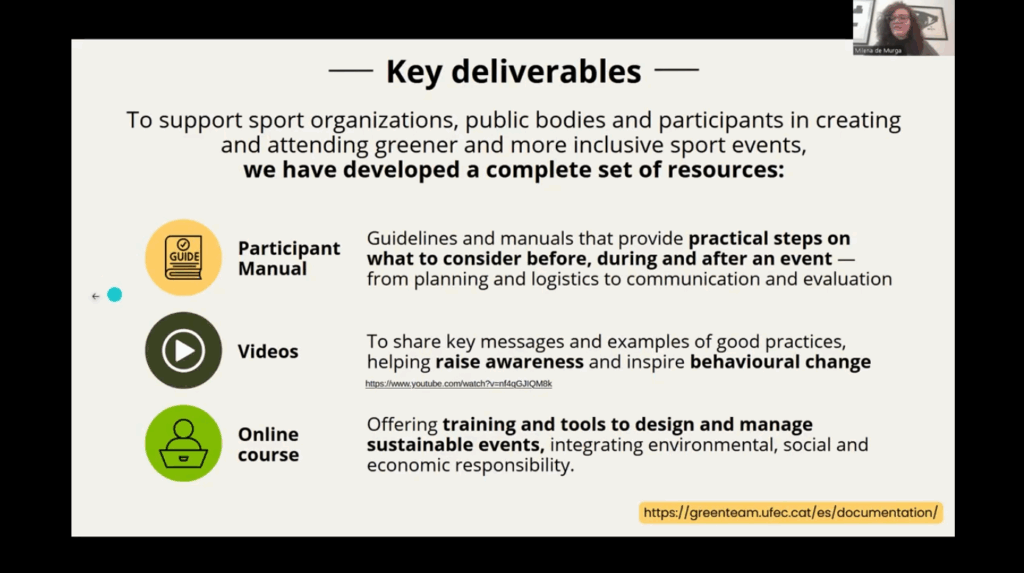
The Green Team project has produced several of these, including manuals, videos, training modules, labels, and event templates, all freely available today.
An online course to professionalize and support change
The second part of the conference focused on the Green Team Online Course, presented by Cristina Ramos, CEO of Ecoserveis.
This 22-lesson module, free and available in multiple languages, offers:
- A clear introduction to the pillars of sustainable development applied to sport (environment, inclusion, economy)
- Practical examples (mobility, waste, water, energy, responsible suppliers)
- Tools to design a sustainability plan
- A self-assessment system and a final certificate enabling organizations to showcase their commitments
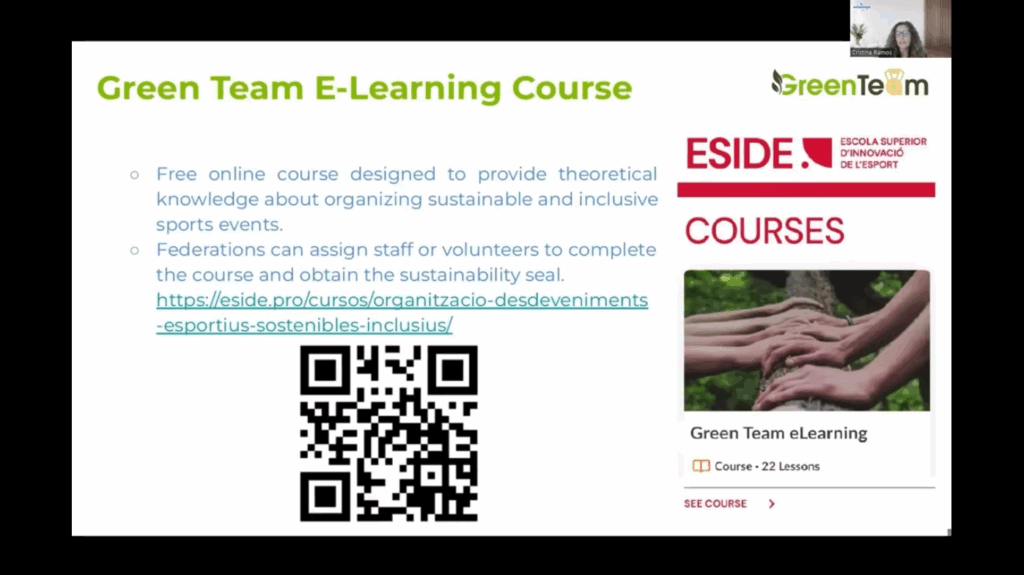
This tool has now become the cornerstone of the project, guiding federations step by step from event planning to evaluation.
When federations take action: three inspiring experiences
The next session gave the floor to organizations that have tested the Green Team methodology in the field. They demonstrated that sustainability in sport is not a constraint, but an opportunity to rethink events and reach new audiences.
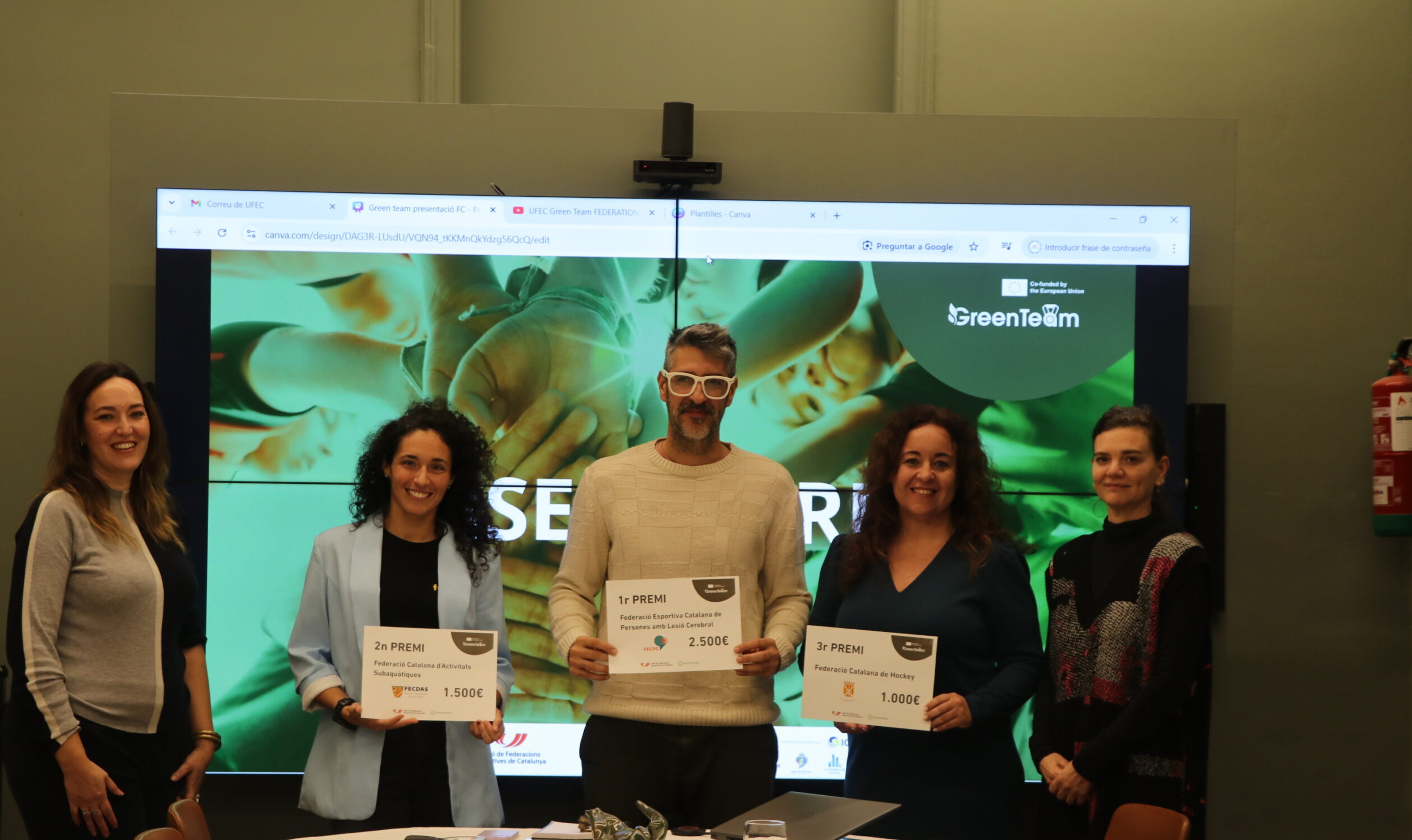
1. FECDAS – Underwater activities supporting marine protection
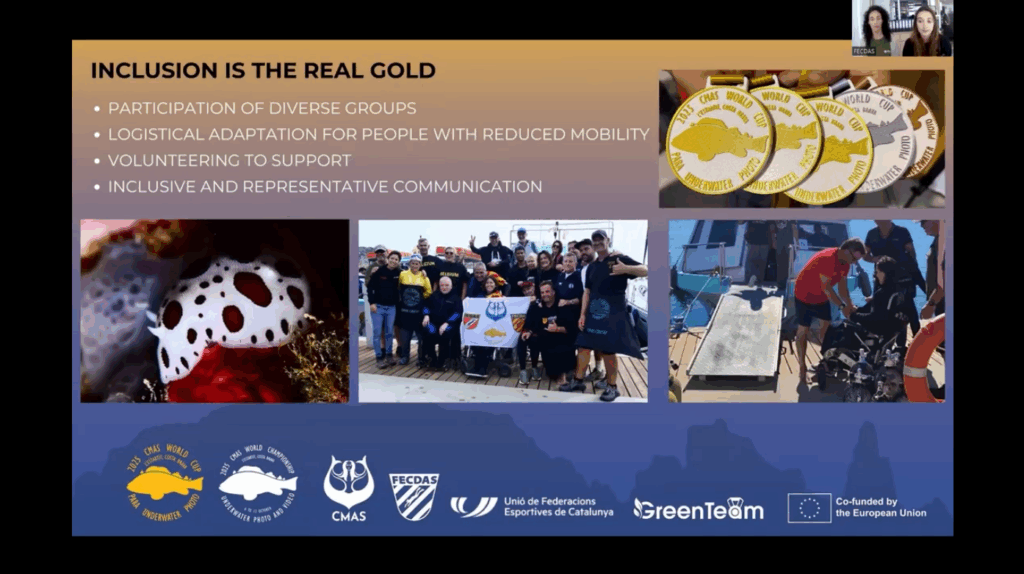
Presented by Laura de Miguel Jiménez and Aline Meme Gallo, FECDAS’ initiatives particularly impressed the audience.
During the Underwater Photography World Championships, the federation implemented:
- A strict protocol for interacting with the marine environment
- Eco-briefings
- Reusable equipment
- Optimized water and waste management
- Educational actions with schools
- Strong attention to accessibility
FECDAS also organized the first inclusive Underwater Photography World Cup, a historic moment showing how sport can combine high performance, innovation, and inclusion.
2. FECPC – When inclusion shapes sustainability
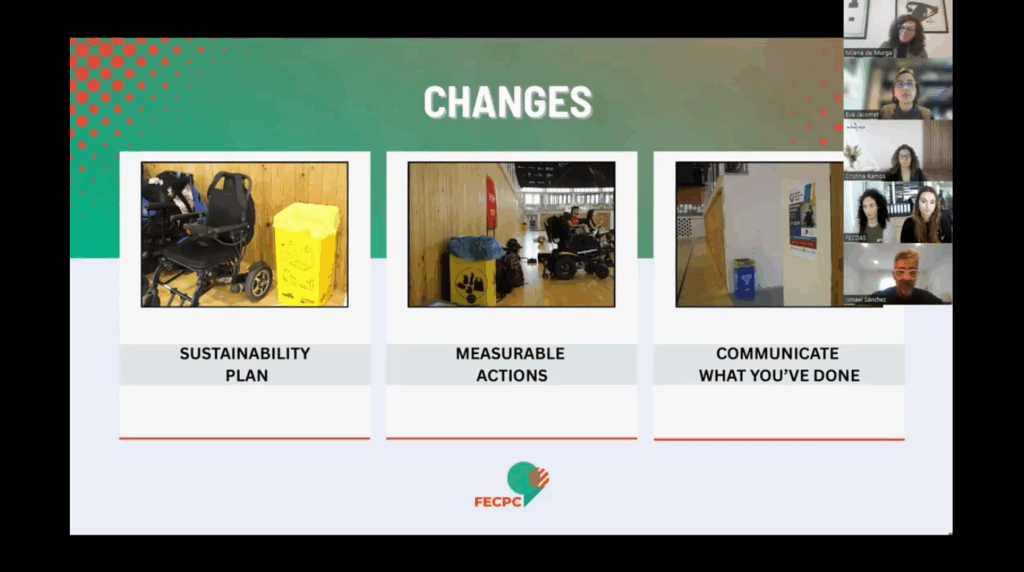
Ismael Sánchez, CEO of the Catalan Federation of Sport for People with Cerebral Palsy, highlighted a key point: inclusion has long been a principle of their work, but it must now be fully integrated into sustainability.
For its events, the federation:
- Redesigned accessible transport and accommodation
- Selected certified suppliers
- Widely communicated best practices
- Implemented simple yet effective solutions, such as reducing print materials and using recycled materials
Their central message is that most solutions are simple, economical, and quickly implementable.
3. Latvian Orienteering Federation – thousands of participants without a footprint

Matiss Ratnieks, project manager, presented “Orienteering Night”, a free, multisite event attracting over 6,000 participants across Latvia.
The federation limited its impact by:
- Drastically reducing print materials to one map per team
- Reusing all equipment year after year
- Avoiding waste and plastic materials
- Involving municipalities in awareness campaigns
This is a highly inspiring example of popular, large-scale sport that is nonetheless very low-impact.
Understanding the context: sport and climate change

At the conclusion of the morning session, Tomàs Molina, physicist, meteorologist for Catalan television, and Ambassador for the European Climate Pact, outlined the urgent trends affecting sport:
- Accelerated temperature increases
- More frequent extreme weather events
- Pressure on water and ecosystems
- Necessary adaptation of schedules, infrastructure, and sporting practices
His intervention highlighted the global challenge, that sport must act now to continue existing tomorrow under acceptable conditions.
KEY TAKEAWAYS
- The Green Team project offers a simple methodology to accelerate the environmental and social transition of sport
- The tools produced, including the online course, guides, videos, and label, are free and immediately usable
- Pilot federations demonstrate that it is possible to significantly reduce event impact while strengthening inclusion
- Sport can become a key driver of change, but it must anticipate the effects of climate change
The momentum does not stop here, as partners will explore ways to extend the approach to clubs, local authorities, and European sports networks